

If you want more qualified traffic without burning out your team, the answer is simpler than most founders expect: build an SEO system that maps content to buyer intent, not just keywords. A strong seo content strategy for saas founders helps you publish with purpose, rank for the right problems, and create assets that keep compounding long after launch.
The goal is not to blog more for the sake of volume. It is to create a repeatable engine that turns search demand into demos, trials, and pipeline while keeping your team focused on product and growth.
Why SEO matters so much for SaaS founders
SaaS growth gets expensive fast when every new lead depends on paid acquisition or outbound. SEO gives you a way to capture people who are already looking for a solution, especially when they are researching a problem, comparing tools, or trying to choose the right approach.
For founders, the biggest advantage is durability. A well-optimized article can bring in traffic for months or years, which is exactly why content becomes a strategic asset instead of a short-term campaign.
SEO is not just traffic, it is demand capture
The best SaaS content does three things at once:
- Educates the reader
- Builds trust in your category expertise
- Moves people closer to a product decision
That means your content should answer questions your buyers are already asking, then naturally connect those answers to your solution.
The real problem most SaaS blogs have
Most SaaS blogs fail because they are either too broad or too promotional. Founders often publish generic thought leadership, product updates, or isolated keyword posts with no path to conversion.
If a reader cannot clearly understand who the post is for, what problem it solves, and what to do next, the content usually will not rank well or convert well.
Start with a buyer-first keyword map
Before writing anything, map your content to the stages of your buyer journey. That is where a smart seo content strategy for saas founders starts to outperform random publishing.
Think in terms of intent buckets:
- Problem aware, the reader knows the pain but not the solution
- Solution aware, the reader is comparing approaches
- Product aware, the reader is looking at specific tools
- Decision ready, the reader wants proof, pricing, and differentiation
Build clusters, not one-off posts
A cluster gives search engines and readers a clear signal that you own a topic. For example, if you sell workflow automation software, one cluster might include:
- What workflow automation is
- How to automate repetitive SaaS operations
- Workflow automation vs manual processes
- Best workflow automation tools for startups
- How SaaS teams save time with automation
That cluster structure helps you rank across multiple related queries and keeps your internal linking natural.
Focus on long-tail keywords first
Founders usually do better with long-tail keywords than broad head terms. Long-tail searches are less competitive and often show stronger intent, which makes them ideal for early traction.
Examples include:
- how to improve organic traffic for a SaaS startup
- SEO content strategy for B2B SaaS
- best blog topics for SaaS founders
- how SaaS companies rank on Google faster
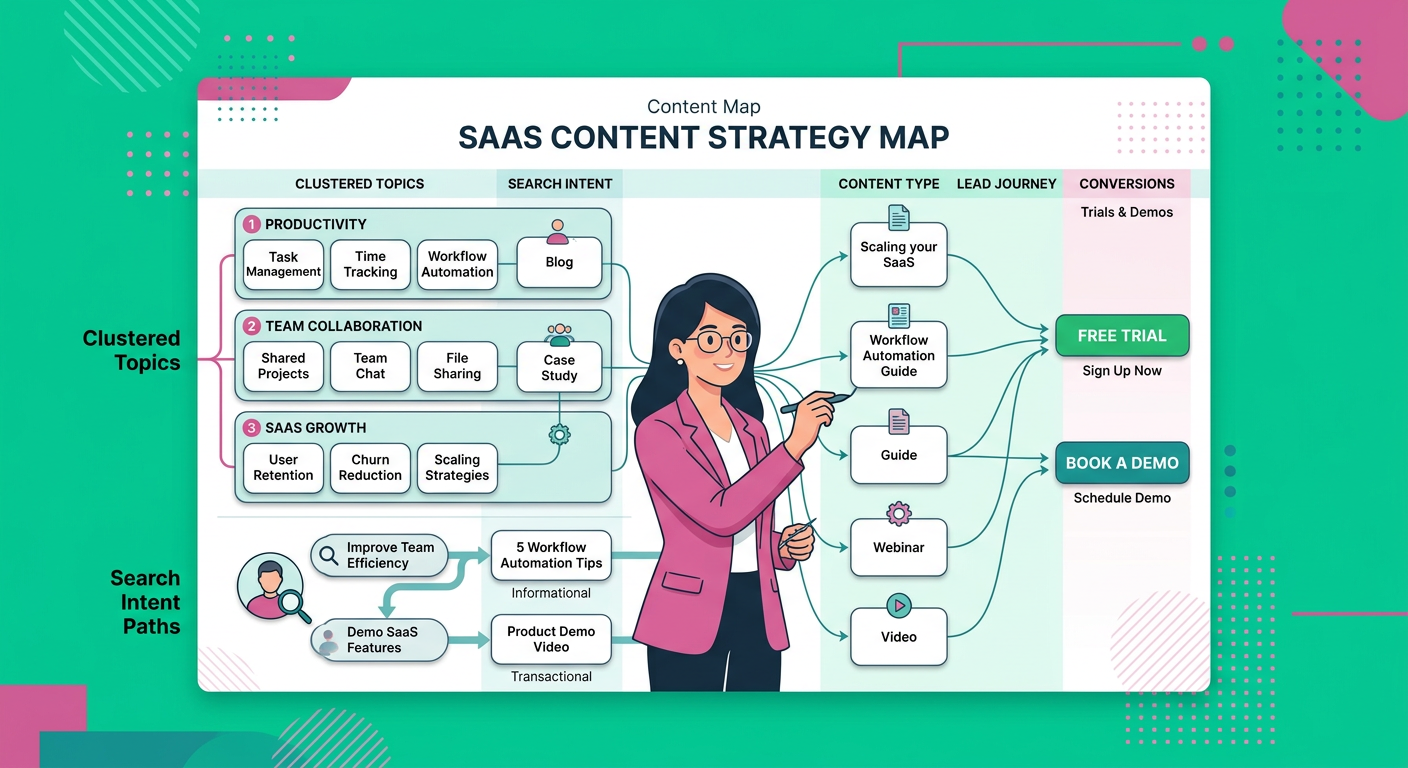
Build content around revenue, not vanity metrics
Traffic is nice. Pipeline is better. That is why your content plan should prioritize pages that can support acquisition, activation, retention, or expansion.
Instead of asking, “What should we blog about?” ask:
- What are our buyers searching before they buy?
- What objections slow down conversion?
- What features need clearer explanation?
- What comparison pages could influence decision-making?
Content types that usually work best for SaaS
Here are the formats that tend to drive meaningful organic growth:
Problem-solving guides
These answer pain points your audience already feels. They work well for top-of-funnel traffic and can introduce your category.
Comparison pages
These capture high-intent readers who are choosing between tools or approaches. They often convert well because the user is close to action.
Use case pages
These show how your product fits a specific job, industry, or team. They are especially effective when your product serves multiple segments.
Alternative pages
These help you rank for brand-aware searches and can win traffic from people actively evaluating competitors.
Integration and workflow content
These pages can attract users searching for how tools work together, which is often a strong indicator of purchase intent.
Create a simple content system you can actually maintain
A lot of founders overcomplicate SEO. You do not need a giant editorial machine to get started. You need a process you can repeat every week.
Use this weekly framework
- Pick one topic cluster
- Choose one primary keyword and a few supporting queries
- Outline the search intent and conversion goal
- Write the article or brief it to a writer
- Add one relevant internal link from an existing page
- Publish, then revisit performance in 30 to 60 days
This gives you consistency without turning content into a full-time distraction.
Make every piece do more than one job
A strong content asset can be repurposed into:
- A newsletter segment
- A sales enablement link
- A social post
- A demo follow-up resource
- A landing page support asset
That is how founders get more leverage from each article and lower the cost of content production.
Optimize for rankings and AI visibility
Search is changing fast, and many teams now want visibility in both Google and AI-driven answers. That means your content should be clear, specific, and easy to summarize.
Write in a way that machines and humans understand
Use simple headings, direct answers, and concise explanations. Avoid stuffing jargon into every paragraph.
To improve your chances of being surfaced in AI search experiences, make sure each article includes:
- Clear definitions
- Structured headings
- Specific examples
- Direct answers to common questions
- A logical flow from problem to solution
Add proof wherever you can
Readers trust content more when it includes evidence. Use real examples, customer outcomes, product data, or external sources where appropriate. If you cite industry information, link to authoritative sources such as Google’s Search Central documentation or respected research publications.
What to prioritize in the first 90 days
If you are just getting started, do not try to cover everything. Focus on a few high-impact wins that build momentum.
Month 1, foundation
- Define your target personas
- Identify 3 to 5 core topic clusters
- Audit your existing content
- Find pages with ranking potential and update them
Month 2, production
- Publish 4 to 8 high-intent articles
- Build internal links between related pages
- Add clear calls to action
- Align content with product use cases
Month 3, optimization
- Refresh content based on early impressions and clicks
- Improve underperforming titles and meta descriptions
- Add missing FAQs and examples
- Double down on topics driving demo interest
Common mistakes SaaS founders should avoid
Even strong products can struggle with SEO if the content strategy is off.
Writing for everyone
If your content speaks to the entire internet, it usually speaks to no one. Be specific about the industry, role, and pain point.
Chasing only high-volume keywords
Big keywords can look attractive, but they are often too competitive and too broad. A focused seo content strategy for saas founders usually wins faster with intent-rich topics.
Ignoring conversion paths
If a post ranks but never sends readers anywhere useful, you are leaving money on the table. Every page should have a logical next step.
Publishing without updating
SEO is not one-and-done. Freshness, accuracy, and internal linking all matter over time.
How automation can help you scale content without chaos
Founders usually want consistency, but not at the expense of time or quality. That is where automation becomes useful.
You can automate parts of the workflow like:
- Topic research
- Brief creation
- Content outlines
- Internal link suggestions
- Content refresh reminders
- Publishing workflows
The point is not to remove strategy. The point is to remove the repetitive work that slows teams down, so you can publish more consistently and spend more time on growth.
If you want a practical way to do that, a system like ContentBeast can help streamline blogging, SEO, and automation so your team is not starting from scratch every week.
FAQ
What is the best seo content strategy for saas founders?
The best strategy starts with buyer intent. Build topic clusters around the questions, comparisons, and use cases your ideal customers search before buying.
How many blog posts should a SaaS company publish?
There is no perfect number, but consistency matters more than volume. Even a few high-quality, well-optimized posts per month can outperform frequent low-value publishing.
Should SaaS founders write top-of-funnel or bottom-of-funnel content first?
Start with a mix, but prioritize pages that can drive qualified traffic and support conversion. Problem-solving guides and comparison pages often create the fastest momentum.
How long does SEO take for SaaS companies?
SEO usually takes time to compound. Early improvements can show in weeks, but meaningful traction often builds over several months as content gets indexed, linked, and refined.
Do SaaS founders need a big content team?
No. A lean team can do well with a focused strategy, good prioritization, and a repeatable workflow. Automation can help fill gaps when time and resources are tight.
How do I know which keywords to target?
Choose keywords that match a real customer problem, a likely buying question, or a comparison your prospects already care about. If the topic can connect to your product and a conversion step, it is probably worth considering.
Grow with a simpler content system
If you are a founder, your job is not to become a full-time content manager. Your job is to build a growth engine that brings in traffic, trust, and revenue without constant manual effort.
That is why a focused seo content strategy for saas founders works so well. It helps you publish with purpose, rank for the right searches, and create a repeatable system that keeps working after the article is live.
If you want more traffic, more consistency, and less content chaos, start with one cluster, one workflow, and one clear next step. Then keep improving from there. For a faster path, ContentBeast can help you build and scale that engine without the usual bottlenecks.