

Scaling content output for agencies is one of those goals that sounds simple until the workload piles up. You need more content, better consistency, faster turnaround, and stronger results, all without burning out your team or blowing up margins.
The good news is that scaling does not have to mean hiring a giant team or churning out shallow content. With the right workflow, tools, and standards, you can increase output while keeping quality high and costs under control. That is where a smarter content engine makes all the difference.
What Scaling Content Output for Agencies Really Means
Scaling content output for agencies is not just about publishing more posts. It is about building a repeatable system that helps your team create more high-quality content with less friction.
For agencies, that usually means more than writing. It includes research, SEO planning, briefs, editing, approvals, formatting, publishing, and reporting. If any one of those steps slows down, output drops fast.
The real bottlenecks behind slow production
Most agencies do not struggle because their writers are lazy or their clients are impossible. They struggle because the process is fragmented.
Common bottlenecks include:
- Rewriting the same strategy from scratch for every client
- Weak briefs that create too many revisions
- Too many manual handoffs between teams
- Inconsistent SEO workflows
- Limited time for content ideation and optimization
- No standardized quality checklist
When you fix the process, you unlock scale.
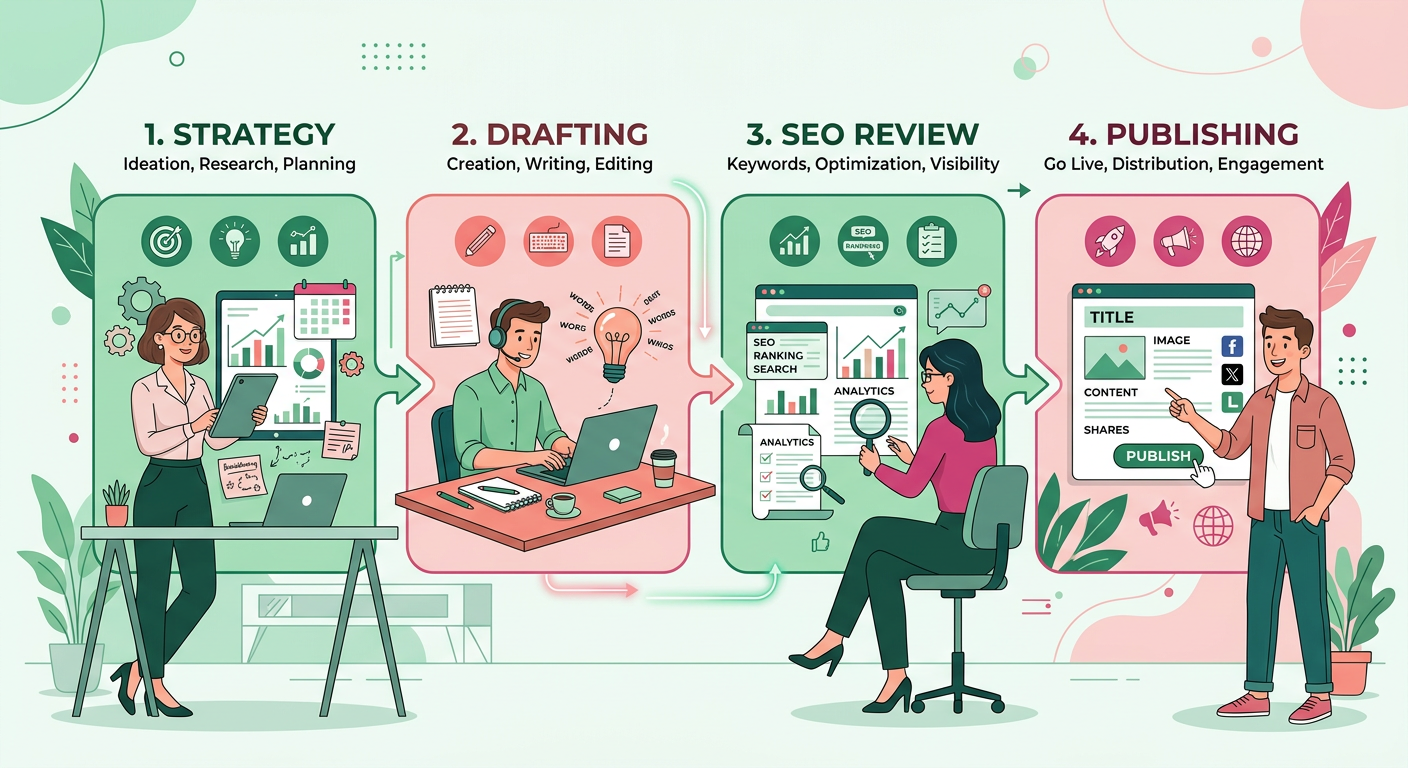
Build a Content System Before You Try to Scale
If you want sustainable growth, start with a system, not just volume goals. Agencies that scale well usually have documented workflows that anyone on the team can follow.
That system should include templates for:
- Content briefs
- Blog outlines
- SEO checklists
- Client approval notes
- Editing and QA steps
- Publishing and repurposing workflows
Standardize your brief process
A strong brief saves hours later. It should define the target audience, search intent, primary keyword, secondary angles, internal link suggestions, CTA, and content goal.
The more clarity you give upfront, the fewer revisions you will need later.
Create reusable content frameworks
Instead of reinventing every article, build repeatable structures for common content types. For example:
- How-to guides
- Comparison posts
- FAQ articles
- Listicles
- Thought leadership posts
- Product-led SEO pages
This is one of the easiest ways to speed up production without sacrificing quality.
Use Automation to Remove Repetitive Work
Automation is not about replacing creativity. It is about removing the repetitive tasks that drain time and energy.
For agencies, automation can help with:
- Topic research workflows
- Keyword clustering
- Brief generation
- Content calendars
- Publishing reminders
- Reporting summaries
- Content repurposing
Where automation makes the biggest difference
The highest-value use cases are usually at the edges of the workflow. Think planning, coordination, formatting, and reporting.
That frees your humans to focus on strategy, messaging, and quality control, which is where agencies actually win.
Pair automation with editorial oversight
The goal is not to publish faster at the expense of accuracy. It is to create a production model where automation handles the routine work and editors protect the final output.
That balance is especially important for agencies serving SaaS, e-commerce, and B2B clients, where search performance and brand trust matter.
Scaling Content Output for Agencies Without Hiring Too Fast
A lot of agencies think scale means expanding headcount immediately. That is not always true.
Before you add more people, look for ways to improve throughput per person. Often, the biggest gains come from eliminating wasted time rather than adding more bodies.
Improve writer efficiency
Give writers better inputs, clearer examples, and tighter deadlines. A well-structured brief can cut draft time dramatically.
You can also improve efficiency by maintaining a shared library of:
- Proven headlines
- CTA examples
- Intro formulas
- SEO templates
- Brand voice notes
Batch similar work together
Context switching kills productivity. Instead of jumping between strategy, drafting, editing, and reporting all day, batch related tasks together.
For example:
- Monday for planning
- Tuesday and Wednesday for drafting
- Thursday for editing
- Friday for publishing and reporting
That kind of rhythm keeps production moving.
Keep Quality High While Increasing Volume
Scale without quality is just noise. If your content does not rank, convert, or build trust, more output will not help.
A strong quality system should review:
- Accuracy
- Search intent match
- Readability
- Internal linking
- CTA clarity
- Brand alignment
- On-page SEO basics
Use checklists for every stage
Checklists may sound boring, but they prevent expensive mistakes. Even a simple QA checklist can reduce missed links, broken formatting, thin sections, and inconsistent messaging.
Measure results, not just output
It is tempting to celebrate word count or post count. But agencies should track outcomes like:
- Organic traffic growth
- Keyword rankings
- Leads and conversions
- Time to publish
- Revision rate
- Client retention
That is how you know scale is actually working.
What High-Performing Agencies Do Differently
The best agencies treat content production like a product, not a one-off service.
They build repeatable systems, they document what works, and they constantly refine the workflow based on performance data. That mindset creates compounding gains over time.
They use content to support business outcomes
Strong agencies do not just ask, “How many articles can we ship?” They ask, “What content will drive the most value for this client right now?”
That might mean:
- Ranking for high-intent keywords
- Building topical authority
- Supporting product launches
- Increasing demo requests
- Creating reusable content assets
Common Mistakes That Slow Agency Growth
Even good teams make avoidable mistakes when trying to scale.
Mistake 1, scaling before systemizing
If your process is messy at five posts a week, it will be chaos at twenty.
Mistake 2, relying on hero employees
When all knowledge lives in one person’s head, the team cannot grow smoothly.
Mistake 3, overcomplicating approvals
Too many review layers slow everything down and create decision fatigue.
Mistake 4, ignoring reuse opportunities
One good article can become social posts, email copy, landing page sections, and client education material.
Mistake 5, treating automation as optional
Manual workflows do not scale well for agencies that want consistent output and lower costs.
How ContentBeast Fits Into a Scalable Workflow
If your agency is trying to grow content output without adding unnecessary overhead, a system like ContentBeast can help streamline the process.
The real advantage is consistency. When blogging, SEO, and automation work together, your team spends less time on repetitive production and more time on strategy, quality, and client growth.
That is especially useful for agencies serving clients who need faster marketing wins, steady publishing, and better visibility in both Google and AI-powered search tools.
FAQ
How do agencies scale content output without lowering quality?
They use standardized briefs, repeatable workflows, editorial checklists, and automation for repetitive tasks. Quality stays high when humans focus on strategy and review.
What content types are easiest to scale for agencies?
How-to posts, FAQ content, comparison articles, and templates are usually easier to systemize. These formats are repeatable and work well across many niches.
Do agencies need more writers to scale content?
Not always. Better systems, clearer briefs, and automation can increase output before headcount needs to grow.
How can agencies reduce revision cycles?
Give clearer briefs, define brand voice expectations upfront, and use a consistent approval process. The fewer assumptions writers make, the fewer revisions you will need.
What role does SEO play in scaling content production?
SEO helps agencies prioritize content that can actually rank and bring traffic. Without SEO, more content often means more effort with weaker results.
How can small agencies compete with larger content teams?
By being faster, more focused, and more systematic. Small agencies often win when they have a stronger workflow and a clearer niche.
A Smarter Way to Scale
Scaling content output for agencies is not about doing everything manually at a faster pace. It is about building a system that makes quality output easier to repeat.
When you combine strong strategy, automation, and clear processes, your agency can publish more consistently, serve more clients, and protect margins at the same time.
Grow Your Agency Content Engine
If you want a simpler way to produce more content without the usual bottlenecks, explore how ContentBeast can help. It is built to support consistent blogging, better SEO, and scalable content production for teams that want results without the grind.
Visit https://contentbeast.com to see how a smarter workflow can help your agency grow.
Conclusion
The agencies that scale best are not the ones working the hardest, they are the ones building the best systems. Once your workflow is standardized, your team can create more content with less friction and better results.
That is the real win, more output, stronger SEO, lower costs, and a process your team can actually sustain.